
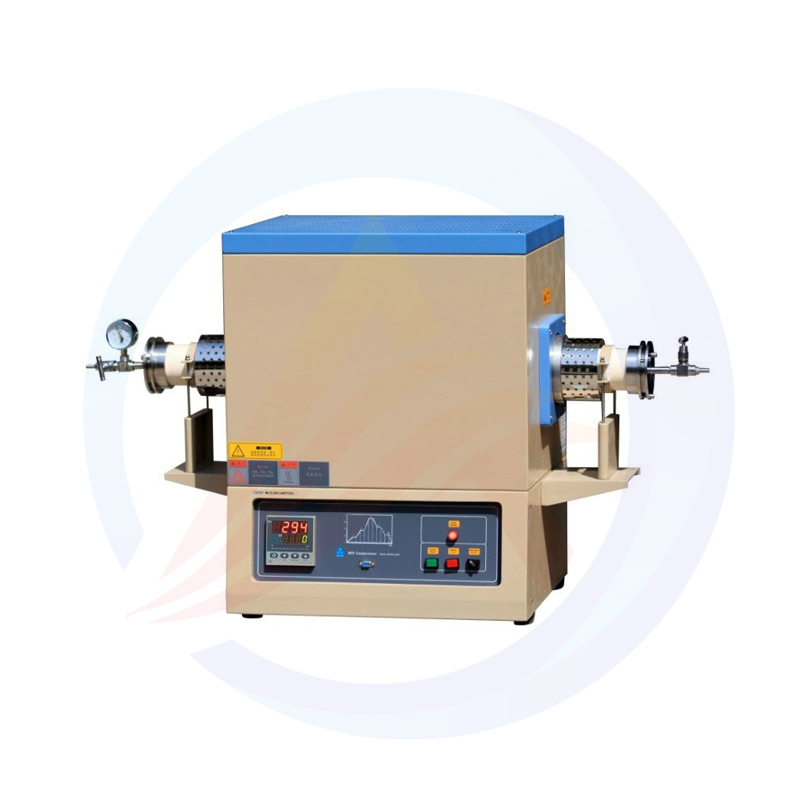
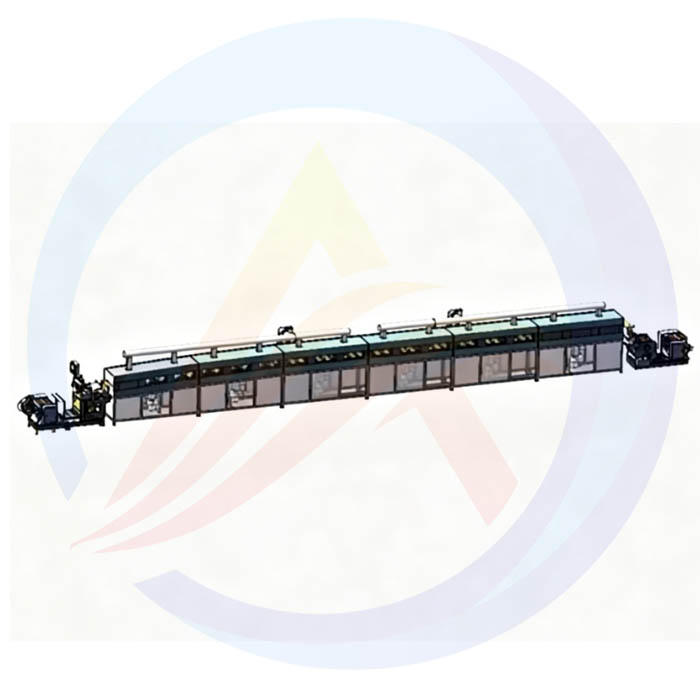
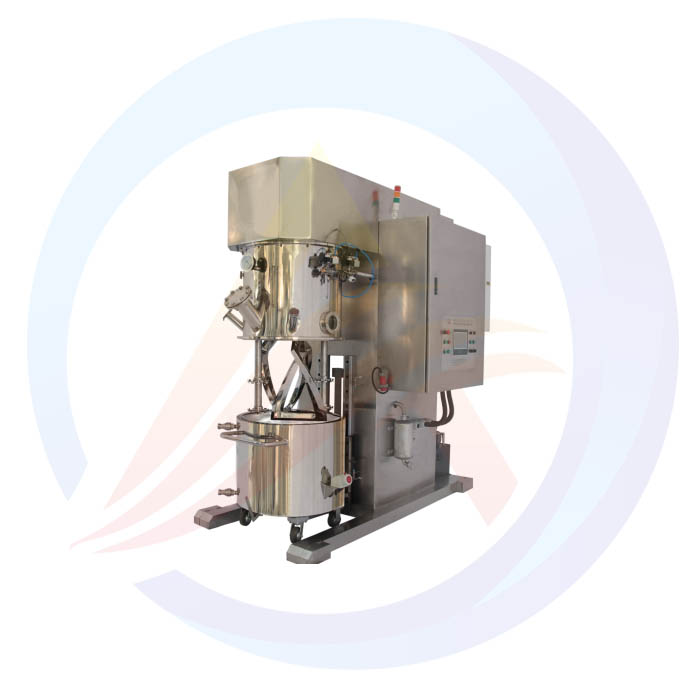
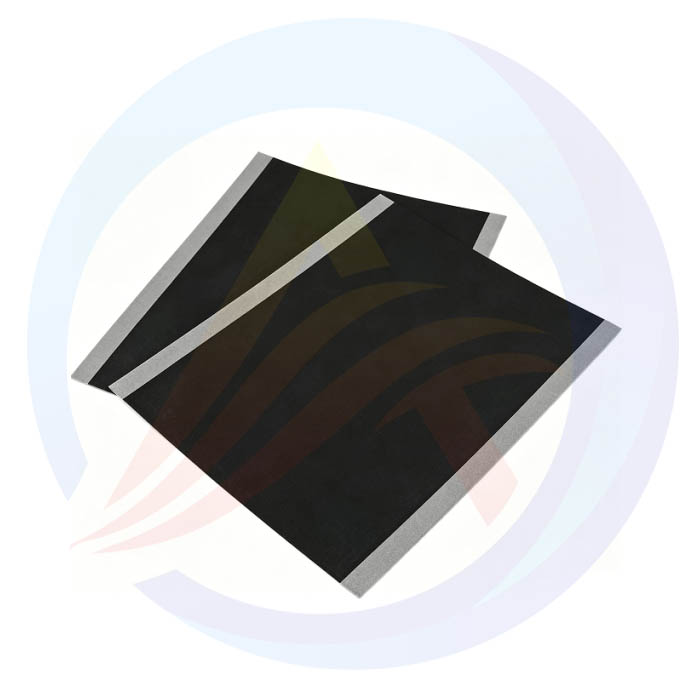
Amid the rapid development of the new energy industry, lithium batteries, as the core energy carrier for new energy vehicles, energy storage power stations, 3C electronics and other fields, have seen their performance and safety become the core pursuit of industrial technological iteration. In the entire R&D and production process of lithium batteries, the vacuum drying process is a key procedure to ensure battery quality. A vacuum drying oven tailored to the characteristics of lithium battery materials has become an essential piece of equipment for research institutions and manufacturing enterprises. Relying on its core advantages of low-temperature high efficiency, oxidation resistance and high-precision control, it provides a solid equipment support for the high-quality development of the lithium battery industry.
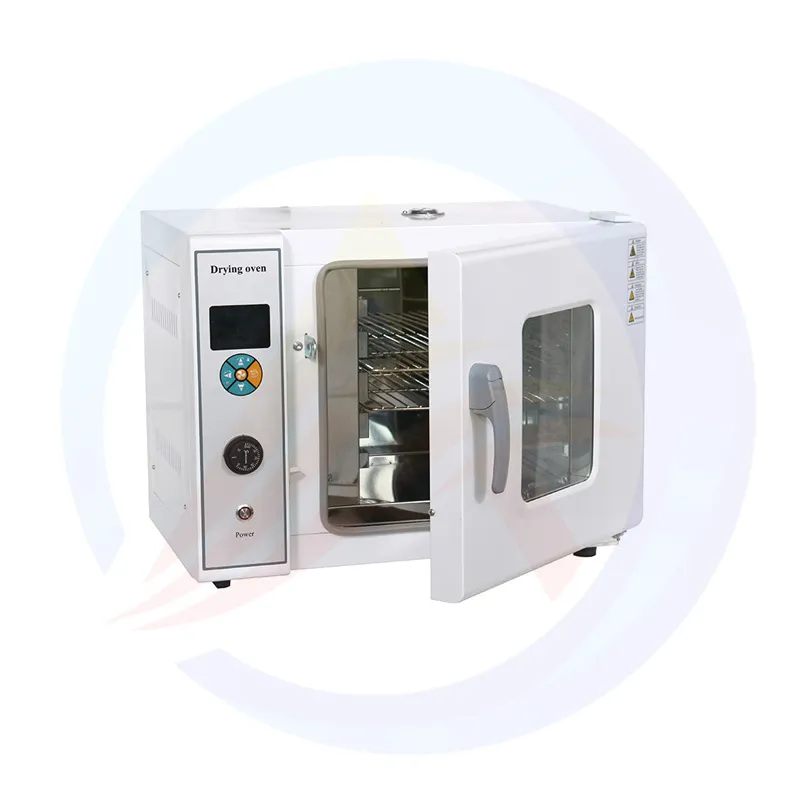
The performance and service life of lithium batteries are directly affected by the drying degree of materials from the source. Moisture and oxygen are the "invisible killers" of lithium battery materials. Cathode ternary materials, lithium iron phosphate and anode graphite materials all have strong water absorption. Incomplete drying will not only cause residual moisture to embed into the material lattice, leading to particle expansion and pulverization and reducing battery energy density, but also react with lithium salts in the electrolyte to generate corrosive gases, corrode electrodes and separators, and trigger safety hazards such as internal short circuits, bulging and even fire and explosion of batteries. In addition, the oxidation problem during high-temperature drying will greatly reduce the electrochemical activity of electrode materials, resulting in the decline of battery charge-discharge efficiency and cycle life. Data shows that when the moisture content of lithium battery pole pieces exceeds the standard, the initial charge-discharge efficiency of the battery will decrease significantly, and the cycle life may even be shortened by more than 30%. Therefore, achieving precise, efficient and damage-free drying treatment according to the characteristics of lithium battery materials has become a core demand for lithium battery R&D and production.
The vacuum drying oven specially designed for lithium battery R&D and production has become an ideal choice for drying lithium battery materials by relying on the unique advantages of the vacuum environment and fundamentally solving the pain points of traditional drying equipment. Utilizing the principle of reduced liquid boiling point in a vacuum environment, the equipment can achieve rapid dehydration in the low-temperature range, effectively avoiding damage to heat-sensitive lithium battery materials caused by high temperature. At the same time, it completely isolates oxygen, eliminates oxidation reactions of materials during the drying process, and maximally retains the activity of electrode materials. In the meantime, the vacuum environment can quickly extract free water and bound water inside the materials to achieve deep drying, accurately controlling the moisture content of lithium battery materials within the stringent industry standards and eliminating various safety and performance problems caused by moisture from the source.
In terms of technical design and performance, the lithium battery-specific vacuum drying oven fully meets the actual needs of lithium battery R&D and production, demonstrating the characteristics of high precision, high stability and high adaptability. Equipped with a high-precision microcomputer temperature controller, the equipment has a temperature control accuracy of ±0.5℃, with a temperature adjustment range from 10℃ above room temperature to 250℃. It can flexibly set the working temperature and working time of 0-9999 minutes according to the drying requirements of different lithium battery components such as cathode materials, anode materials and battery cells, meeting the diverse drying process requirements. When the drying time is up or an abnormality occurs in the equipment, an audible alarm will be automatically issued to ensure the controllability of experimental and production processes.
In structural design, the inner liner of the equipment is made of 304 stainless steel, which is corrosion-resistant and easy to clean, effectively resisting the corrosion of lithium battery materials and electrolyte, and ensuring the service life and use safety of the equipment. The outer shell is made of high-quality cold-rolled steel plate with electrostatic spraying technology, which is sturdy and durable and has good heat insulation performance. The equipment is equipped with a tempered bulletproof double glass door, facilitating operators to observe the internal drying situation in real time. Meanwhile, it is provided with multiple safety devices such as over-temperature protection and grounding protection, comprehensively avoiding safety risks during the operation of the equipment. In addition, the equipment is standard equipped with various types of stainless steel shelves, which can be flexibly selected according to the characteristics of dried materials, ensuring the uniform temperature distribution inside the oven, improving drying consistency, and meeting the diverse needs of small-batch R&D and small-scale production in laboratories.
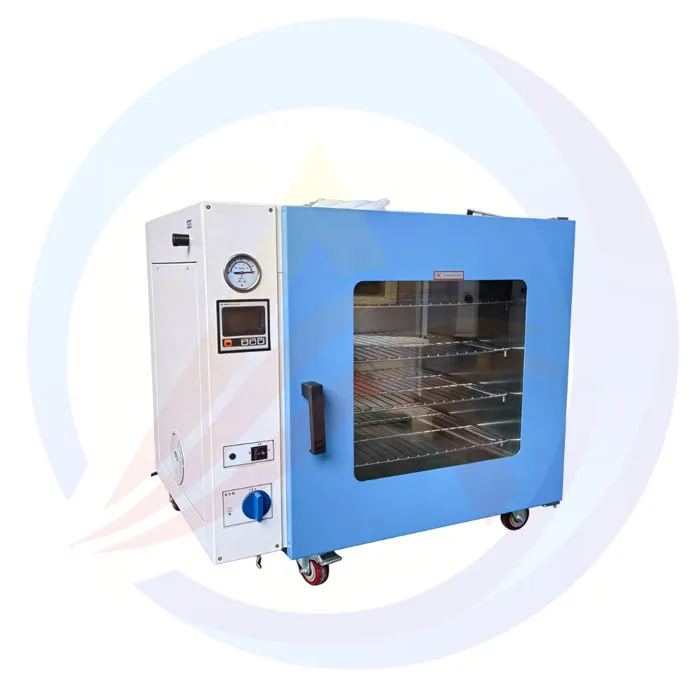
In addition to core drying performance, this vacuum drying oven has multiple practical advantages, adapting to the full-scenario needs of lithium battery R&D and production. The equipment can achieve a high vacuum degree of -0.1MPa, which can quickly complete material dehydration, greatly shorten the drying cycle and improve R&D and production efficiency. There is no air flow in the vacuum environment, which effectively avoids the pollution of lithium battery precision materials by dust and ensures material purity. In terms of supporting services, the equipment is provided with a full set of accessories and an English operation manual, matched with a customized power plug and a special vacuum pump, which can be put into use immediately after unpacking. At the same time, it enjoys a one-year limited manufacturing warranty and lifetime technical support, providing a guarantee for the long-term use of research institutions and enterprises.
At present, this vacuum drying oven has been widely used in lithium battery R&D laboratories, university new energy research centers and small-batch trial production links of lithium battery manufacturing enterprises. It is not only suitable for the drying treatment of lithium battery cathode and anode materials and battery cells, but also can meet the disinfection and sterilization needs of various glass containers in the battery production process. It also plays an important role in material drying and heat treatment in many fields such as biochemistry, chemical and pharmaceutical manufacturing, and environmental testing. Especially for the drying treatment of heat-sensitive, oxidizable and decomposable materials in lithium battery R&D, the equipment can achieve fast, efficient and damage-free drying effects, providing precise equipment support for the R&D of new lithium battery materials and process optimization.
With the continuous upgrading of the new energy industry, lithium batteries are developing towards the direction of high energy density, high safety and long cycle life, and the requirements for production and R&D equipment are also constantly improving. As a key equipment for lithium battery R&D and production, the technological innovation and performance upgrading of vacuum drying ovens will continue to empower the lithium battery industry. In the future, relying on precise process control and design optimization that meets industry needs, vacuum drying ovens will play a greater role in the R&D of new lithium battery materials, process iteration and quality improvement, build a solid equipment foundation for the high-quality development of the new energy industry, and help lithium battery technology move towards a higher level.